Steve Snedeker’s Landscaping and Gardening Blog


May 30, 2009

The Incredibly and Fantastically Boring Driveway- Part 1

Category: Brick Paver Installation – Steve – 6:42 am

Is there anything – anything at all we can do for this irritating conundrum of the modern driveway? Our very entrance way itself, in most cases, stands there – entirely composed of some monolithic cement or asphalt slab of matter, uni-colored, boring, cracking and getting uglier by the millisecond, exponentially, the more we look at it. We typically work around these monstrosities of glare, doing our best to prettify things by planting abundant color or weird plantings abutting them, simply to dress them up a bit and to somehow make them become something they are decidedly not. No, those concrete driveways are no Prom Dates, for sure. In fact, they are not even suitable for masks or the infamous paper bags.

So what is to be done? Owing to their size alone, driveways are money pits, aren’t they? How on earth can one recoup what they spend on a driveway??? Lord love a duck, but they are huge! What’s the dang deal? How can Steve – or anyone else NOT in the paving field – advocate spending that kind of dough on something so basic and utilitarian as a stupid driveway? And, let me ask this now: “What’s in it for me? Hey, Steve tells great jokes. My hubby even likes him! I like Steve and I like that he buys his meals off my dollar now and then, but isn’t he being just plain selfish asking me to redo that admittedly homely-looking expanse I call a driveway? Is Steve a shifty-eyed bandit in disguise?”

No, dangit, I am not a shifty-eyed bandido, snarfing for your landscaping buck and sentencing you to an eternity of good gardens in the midst of some miserable and penurious existence. I am here to help! Remember me? I’m one of the good guys! And today, I don’t care about your garden at all. I want to sincerely give you the place you have always wanted and I want to make it last a while. You go prune the roses and let me “garden” that Godawful driveway of yours. Dear, you too, Sir – you guys need help. Stand aside and listen up.

Driveways of poured cement and of asphalt have a life expectancy of around 20 years, at best. Depending, of course, on the mix one uses, I hasten to add. But most of us deal with what we have. Typically, the modern cement driveway is poured of standard cement with a PSI rating of around 3500 PSI. The numbers of homeowners who do not trust this rating to yield anything more than some mind-boggling and useless bit of information are the same ones – us! – who simply want the doggone thing poured and to get the installers out of our hair. But this matters. It matters immensely, it turns out.

All cost benefit analyses comparing a poured cement or asphalt slab over time to that of, say, interlocking brick pavers, reveals that a cement driveway will be replaced at least 3 times over a period of 30 years. In that same period, the brick paver driveway will sit there, intact and being itself for that entire period. In truth, in the more challenging weather environments, that ratio worsens. The smallest margins of error in terms of drainage or compaction degrees under the surface of a monolithic slab can render a cement driveway useless and broken remarkably faster. This is a truly dispassionate look at a practicality, by the way. It leads to the question regarding a budget seen more over the long term, as opposed to relief of the current driveway-less situation. Or even that facing a homeowner who finds himself replacing his existing cracked and broken monolith once again, hoping against hope this will never recur without really ever knowing why it occurred in the first place.

So why are brick pavers a solution? And, yes, that is where I am going with this. I confess to a bias on the issue, but I think I might just prove the superiority of brick pavers as not only an aesthetic effect, but in also that most important issue of budget. Tune in for more details on this blocky subject. In Part 2, I describe brick pavers in much more detail and I compare them to the other solutions offered in the driveway marketplace. Bring your thinking cap and your eyeballs. Being a bit shy in those area myself, I need the help! I promise this though: I won’t rip you off. This is legit.

May 26, 2009

More On Boring Driveways and Changing That – Part 2

Category: Brick Paver Installation, Design Themes – Steve – 12:57 am

I am recirculating this post and adding to it because I have been getting quite a few calls and mail from people interested in upgrading their driveways. Since I feel I did a pretty good job with this particular post, I’m going to change it just a bit and recirculate it near the top of the blog. Sometimes, people don’t pore over the older stuff in here owing to the sheer quantity of posts I have. I am now categorizing better so that it will be a short walk to see all my relevant examples and explanations displayed easier. The categories are over on the right. Click one to take you there.

So my claim is that driveways constitute a major part of almost any landscape. The move to suburbia over the last 40 years has given Americans at least, homes of substantial size, along with, often, huge lots. Driveways get us up to the door. They are typically darn near the first things we see at a home. They are definitely, generally speaking, the largest things we see. They are also – surprisingly enough – among the most ephemeral. They crack and break and get fairly ugly in due time, causing a need for replacement.

My contention is that this is not necessary at all. Furthermore, I think it is possible to construct a driveway that can meet aesthetic ends as well as an unheard of longer-lasting durability using today’s cement technologies. Interlocking bricks are versatile as they can be, coming in many shapes and patterns – some utterly exotic – and their durability is legendary. Formed in manufacturing by machines that shake out the air voids common to all cement, they are made with additional cement and finer silicates that produce a compressed brick that is an unbelievable 8,500 PSI. To compare this to a typical poured cement driveway, consider that the typical pour uses cement with a rating of 3,500 PSI. Our curbs and gutters on our public streets come in at a “toughened-up” 4,500 PSI. Obviously, the durability is over the top in terms of expected longevity. And there is more, including a value-added dimension which I mention further down.

The segmented nature of their being composed of pieces, each snugly-fit in exact proximity with the fine tolerances and perfect shapes formed in manufacturing, means that they are flexible in essence. The heaving and malformations we see in severe climates which break monolithic slabs of cement and asphalt will not affect the composition of the surface whatsoever. Where monoliths break, then crack wider over time until they essentially disintegrate, brick pavers will be sitting there, intact and unbroken. A crack in a cement slab will never get better. The “cracks are already there” with bricks, something the old road builders knew back when bricks were the thing for streets. Indeed, Vancouver, BC, among other cities, is slowly replacing entire streets with brick pavers.

So we now see that they are a definitely superior product in the sense of durability. What do they cost?

Well, they cost more. Brick pavers typically cost about twice as much as cement and, depending on the pattern and style, they can cost more than that. They are definitely a labor-intensive application and, like all surfaces, depend mightily on the sub strata all being firmly and most completely compacted. That many omit this step in installing cement happens to also be one of its downfalls. This is not as commonly done as we would hope, I happen to know. Costing twice as much is substantial, there is no doubt. You can pay more in the end however just by addressing the same old daggone cement again, taking out the broken shards and re-pouring, ad nauseum. In this case, my point being, you really do pay for what you get. In fact, I would go so far as to say you might well exceed it. For resale purposes as well as general curb appeal, few things match brick paver driveways.

The next factor is Curb Appeal.

Composition, color and special effects can make a driveway something far more than one dreamed. The top picture is a very straightforward look at a simple design using a cheaper paver. It was done for a lady who had tried and tried to chase the cracking driveway she had been driving on for years. She had used patches in the past – ugly swaths of different-colored cement which stood out like a sore thumb. And then they started cracking too. Three of us were able to change that driveway to what you see there – complete with a walkway to her back yard and a patio in the same material – in two weeks.

The final pitch in favor of brick driveways is their resale value. Ask any real estate salesperson if they hold the value of their investment and I wager you’ll get a resounding “Yes!”. At least, in my experience it has been that way. Brick paver constructions tend to be lumped in real estate terminology with the terms “value-added” and “special”. They are often foremost in listings as described “benefits”.

These other pictures illustrate yet more possibilities in driveway compositions. I look at many expenditures in landscaping and wonder why some of it is not investing in driveways which could be made to catch the eye. A cool driveway is a unique and obvious way of welcoming people with pleasure and some style. It does not have to be overwhelming – although it can be – but it can certainly make a place look better. It can – if one wants – also show a bit of whimsy or even creativity. Driveways, like gardens, are opportunities.

May 9, 2009

An Amazing Spring

Category: Gardening and Landscaping – Steve – 6:32 pm

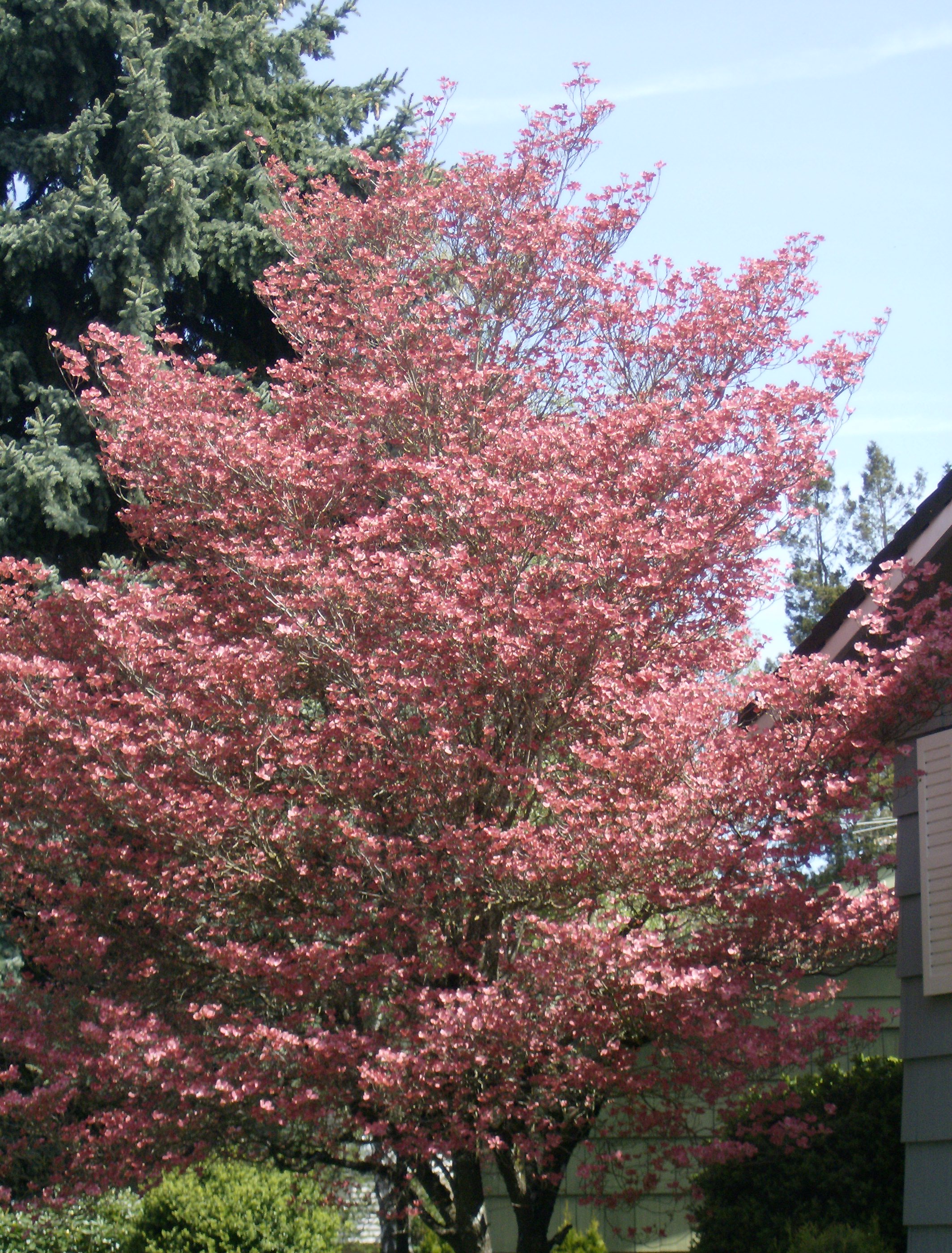
It just gets better this year. I believe the minus 4 degree days back in December set the dogwoods into a true 4 season mode, somehow, maybe even stressing them some – at least enough to produce the local color which has taken over out here in Portland and delivered the most stunning Spring I can ever remember, at least certainly for dogwood trees. The pinks and whites are just stunning!

(click images to enlarge)

All these photos, once again, are from my local neighborhoods. I live near the MAXX Line – the light rail transit system that courses through the city – and amid a mix, therefore of apartments, duplexes and single family houses. The point is this – they are not necessarily any different from any other neighborhood in the town itself. In fact, less grandiose, by far, than other sections. Typically working-class people, many of whom do indeed take pride in their gardens, it nevertheless is not famous for much of anything more than a serious concentration of Mexicans. Now, since I speak Spanish, after all those years working with them, I happen to actually like that.

I have all sorts of subject matter slated for postings but, assessing the remarkably pretty locale, I cannot help an urge to share it with others, maybe, I guess, to brag a little. I think it can be seen as very obvious that what i say is true – that the trees alone are magnificent this Spring season.

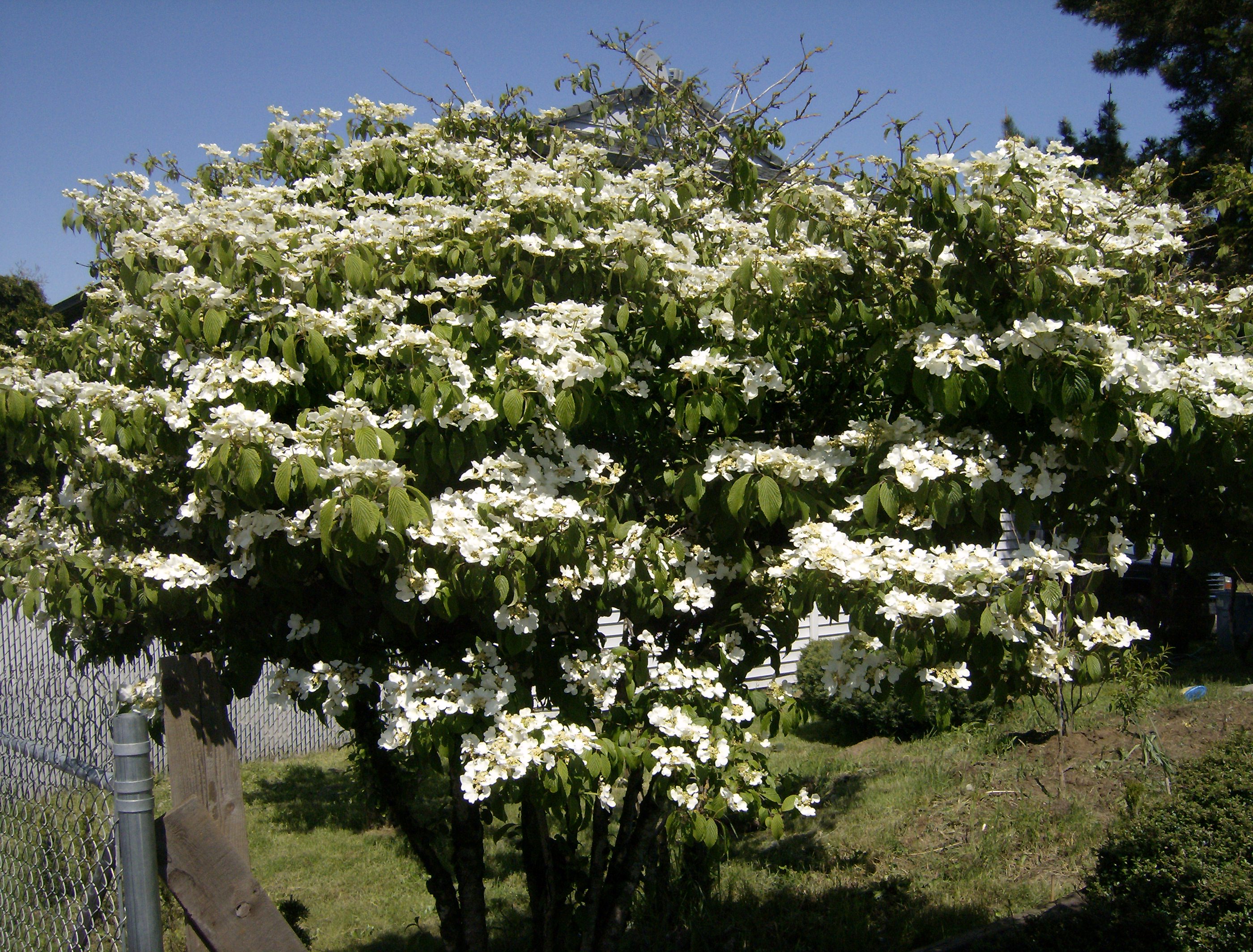
So, while the dogwood trees have taken the full glory for such a resplendent Springtime, other plants are also doing remarkably well. Take this Double File Viburnum, always a favorite of mine. This hulking beast is getting very close to “popping” loud and proud.

This plant will soon be pushing blooms which look like this, a smaller version who has been the beneficiary of far more sunlight:

All those budding blooms on the large plant will pretty much literally cover this Queen of Shrubs, as I have seen it termed. I was shocked to see it last Spring – in all its glory – and resolved then to keep it in mind on my walks around the hood. Here’s an idea of what shape it will take then: (just ten times larger)

Anyway, other local items of blooming interest include the usual raft of rhododendrons. Here is a local I have my eye on:

And these noteworthy fella’s here are all from within a few blocks as well. One thing about the Northwest – it is definitely Rhododendron Country:

There is no bloom quite as rich as a Rhodie. The sheer volume and weight of the blooms is just breathtaking to me and always has been. I have often spoken of the revelation I had concerning this plant and its role in my becoming a landscaper. I had no idea then of just how much more love I would pour their way. They just suit the climate perfectly and make one of the most insanely easy-to-plant and maintain plants in Nature. Tiny little root balls make them imminently transplant able, too.

The colors are amazing, even electric. Here are just a few more:

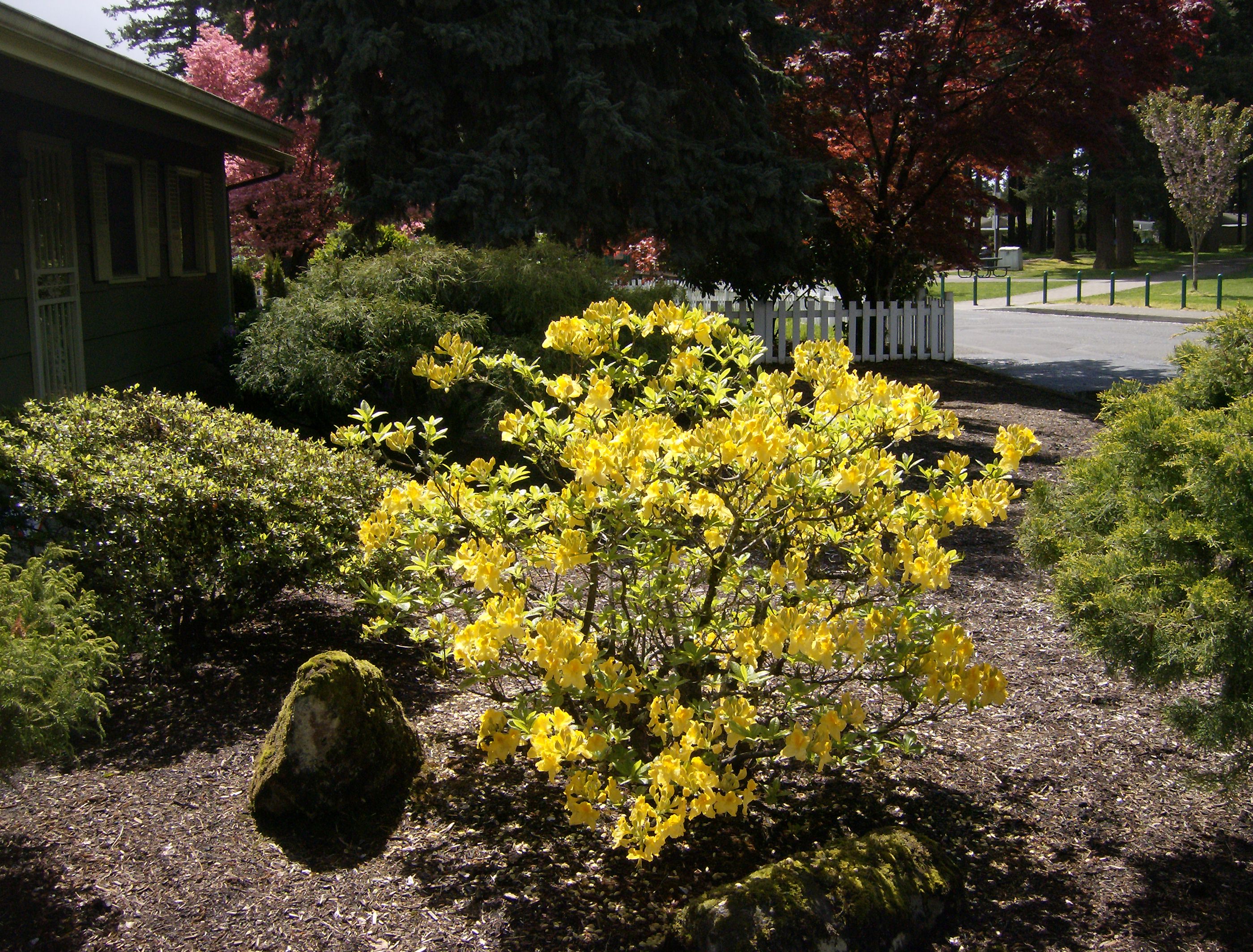
I’ll end with pictures of some local Mollis Azaleas. Back East, Azaleas seem to be king, along, of course, with Dogwoods. These show why, anywhere they grow, they are so appreciated:

And this one is a personal favorite. I walk by it pretty much every day. Here it is on the very verge:

And my tribute to my local Japanese Red Maple:

May 6, 2009

Wordless Wednesday – Cherries and Dogwoods – Portland Spring

Category: Gardening and Landscaping – Steve – 12:06 am

(click on images to enlarge)

May 2, 2009

Boulders and Rock Mulches – Animated Talks With Stones

Category: Gardening and Landscaping, Rocks/Boulders – Steve – 1:51 pm

(click all images to enlarge)

Rocks are some of my best friends. Let’s face it, they offer a minimum of argument over even the thorniest issues and they behave once set into place. There is a lot to be said about this sort of loyal adherence to Natural Law. And, yes, I have abused the odd rock, I admit it freely. I have thrown them, hit them with baseball bats and golf clubs, used them as weapons against my enemies – the “bike-chasing barking dog” for example – and sometimes shamefully using them against bad friends.

Some, however, you can’t do much to. They talk back.

Some of the bigger guys you can tweak with machinery the size of Texas – just make sure they roll in the right direction when you stack ‘em.

This applies to all versions of rocks larger than a fist -

No doubt, you will have noticed right away that the boulders and stones shown so far have all been of the “River Rock” variety – meaning rocks who were either tumbled under glaciers for miles and miles under enormous weight and thereby rendered rounded or else they were immersed in rapids of fast-flowing creeks and rivers with the same result.

Meanwhile

Some other rocks cracked liked broken crystals during some epoch in the less-distant past, immune from the rushing waters of creeks and rivers, and maintaining and still-ancient, yet freshly-fractured look which allows yet another approach to working with them. They can make a bizarre, yet somehow artistic mulch, and one I personally embraced, loving the mix and the radical nature of the stones themselves, especially when mixed with similarly-fractured boulders:

Surprisingly enough, they can even work well in the midst of water – the color and fractured nature revealing sharp breaks which contrast with the softness and depth of the water around it.

All in all, they also take up space and are quite handsome, taken individually – no matter their origin.