
July 31, 2011
So after we admire the incredible work of Patrick Blanc, we return to Earth and find a veritable buzz over the entire Verticality thingy.
We see what the PNC Bank in Pittsburgh, Pennsylvania did and we do a bit of drooling. This, so far, is the single largest Vertical Wall construction in America and comes in at 2,380 square feet, a total of 14,440 plants, stuck up on the side of a building and offering something few other places have: the soft, lush organic features of plants, replete with seasonal changes:
So, First – The Massive Walls
(click any image to enlarge)

As the plantings mature, we pay attention:

While so much of the field is still experimental as it can be, the strides made by Patrick Blanc have offered immediate enthusiasm from disparate people and firms. Even the US federal Government is considering getting in on the act with the addition of a solid planted wall some 250 feet high in beautiful downtown Portland Oregon:

We realize many wonderful results from all these efforts, including impacts on air quality as well as a startling beauty – a blessedly impractical gorgeousness.
What is most interesting about any of these big constructions are the local effects. The intense plantings operate as a virtual “lung”, recycling and purifying the air aspired by the thousands of plants. From the EXPO 2005 Aichi website:
“At both ends of the central large screen, roses and other glamorous flowers are planted in pockets of the canvas made from kenaf and coated with photocatalyst. Other presentations of state-of-the-art greening technologies include sedum vegetation mats pasted over foam resin materials, vines planted over vegetation boards made of peat moss, and lovely wild flowers planted on bog moss.
Bio-lung is sprayed with mist of active water generated by ceramics. This spraying has the effect of cooling the temperature in the area. Bio-lung is designed to absorb carbon dioxide and supply oxygen with the vegetable power, in addition to the cooling effect in the summer months. It thus presents a model for future environmental equipment that will improve the urban environment and reduce environmental impact.”
I like the look, myself.

Before Proceeding: A Caveat
It may also be time for a caveat towards the entire enterprise, just to give a voice to the possibility of failure over time. It pays to go gently into this newer realm of horticulture owing to effects and implications which we are not entirely up-to-date with as yet. There have been some failures, once advertised as ‘no brainer’ success stories and triumphantly announced as the “next new wave”.
This can also happen:

A genuinely sad development, as are all gardening failures, this one the Paradise Park Children’s Centre in London designed and installed for a hefty bit of change and subsequently failed in development. The issue is broached in this article from Jetson Green’s magazine. An excerpt:
“It’s an interesting situation. A lot of green technology is new and using it will certainly be an experiment. Plus, here in the states, public money is chasing LEED and green building, so there will be some high profile blunders — kind of like this one. But after reviewing all the commentary and various articles, there’s still no clear cut articulation of the what exactly happened. Why did Paradise Park Children Centre’s living wall die? Was it the design? Construction? Maintenance? Or some combination of all three?”
The truth is, in landscaping, new technologies give us ways to deal with species’ which are millions of years old, lol. We try all sorts of stuff and sometimes we can’t help trying to fit square pegs into round holes. Some of the earlier efforts, for example, at “Xeriscaping” resulted in preposterous failures as the “drip technology” matured and we found more out about its nuances.
I’ve purloined a picture from a very favorite and quite prolific garden blogger, Alice @ Alice’s Garden Travel Buzz, who I have to insist we all visit regularly. She has also discovered vertical gardening and she has written as extensively as I have on Monsieur Blanc, including his latest effort in San Fransisco, featured in the link.
Here is Alice’s picture taken this year – another year into the floral development – at the Athenaeum Hotel:

Enlarging these photo’s reveals a riveting study in maturation, and in such a short period of time.

Pretty wild stuff.
Next post, we will deal with the “Next Phase” – what works and who is dealing with the future of vertical gardening. In many cases, it might just be fine enough to simply appreciate yet another design innovation made of simple materials, destined for temporary life, recyclable, ultimately re-designable as well. The primary virtue of it all is that we are indeed dealing with plants – what we do from there (outside of feeding and nurturing) is up to the artist in us all:
(this picture taken from a reprint of a photo from Scott at Season’s Landscaping). I really like what they do, down in the L.A. Region.

On a smaller scale – nothing really new here, just pretty as heck, from the Portland, Oregon Vertical gardening experts at the neat Singer Hill Cafe, where I aim to drink a cup o’ Joe in mere days from now as I visit up there:

July 26, 2011
They had to be inevitable, Vertical Gardens, considering all the new stuff in gardening and landscaping – all the newly-discovered potentials in so many varied but congruent technologies and disciplines. The list of such technologies range from modern horticultural discoveries to irrigation technologies to – hardly least important! – waterproofing materials, thence to construction technologies in general.
So where do these modern developments lead us?
To here – Patrick Blanc’s marvelous vertical construction at the Caixa Forum, in Madrid, Spain, in 2007:
(click any images to enlarge when applicable)

The picture above is the current version of this, at its origins:

The mind behind this gorgeous vertical garden is the preeminent designer and very seminal instigator of the field itself, one Patrick Blanc – his more than fascinating website accessible by hitting the link under his name. Blanc was an already-accomplished horticulturist – a scientist and something of a botanical genius. Blanc is affiliated with the CNRS (Centre National de Recherche Scientifique) and also won the French Society Award for Botany in 1993. In short, he knows what he is doing, and is also very good at adapting his genius to a project and then making these things work. Mr. Blanc has authored a fantastic book, chronicling his efforts, called Vertical Gardens – link to Amazon included in this link.
The book is very cool. He speaks of his own methods of trial and error, operating in a field to which he was naturally drawn in his fascination with the upright flora he had seen in his travels. He posts pictures such as the ones below which indicate why his curiosity was so piqued by the potential he saw in these natural sights:

And these, from the book itself, where waterfalls provide the constant moisture leading to such excessive and exquisite natural beauty:

A perusal of his website reveals other wonders, just fabulous renditions of his vision and it has inspired an entire and very burgeoning school of verticality in landscaping in just a few short years – a literal explosion of interest in the gorgeousness and the design potential inherent in such a new and overwhelmingly entertaining area. Here are just a few examples of this man’s exquisite art:


As one can see, there tend to be few limits on Vertical Gardening’s amazing promise. While Blanc’s incredible efforts are not entirely new – one does indeed suddenly acquire an almost instant desire to travel back in time to Babylon – Blanc has certainly acted as the seminal innovator and living advertisement for this intriguing field itself.
The practice and knowledge clustered around Vertical Gardening achieved a ‘critical mass’ in an exceptionally instant, no doubt Internet-driven accumulation of schools, products, certification programs since its recent explosion. And not much of this is a bad thing whatsoever. This is a wrinkle that requires a bit more than my pick up truck and a few shovels.
In part 2, we will visit these equally entertaining places and exhibitions of their results. Here’s one now – shown here at none other than the not-so-stuffy ASLA’s (American landscape Architect Association’s) own website – a picture from the entitled names below the shots.
Anything is possible!

July 22, 2011
Since Burning Man begins in a month – always over the Labor Day weekend, giving yet another insane rendering of “Labor” – and make no mistake, for those Black Rock Rangers and the other intrepid workers who lay out and construct what you see below – there is a ton of work they labor at, in a pleasure so pure it hurts:
(left click images to enlarge)

In the end, a city of 40,000 campers looks just like this:

The efforts get cleaned in a rather dramatic fashion, later, including the burning, as mentioned below, of everything, no matter how temporarily cool:

I’m doing this post to please a friend who asked about what all the hubub was over Burning Man. She had never heard of it. Since I’ve been there, I have my own very personal opinion. So, Marcia – here ya go. The event is coming soon. Adventurous, thought-provoking, anarchistic, artistic – the adjectives flow like water over the Niagra Falls………..in the end, while it is indescribably interesting, make no mistake – it’s fun!

I guess I’m stretching a bit to present what to many is a scandalously misunderstood event in here in my nice conservative, construction and design-related blog, but I feel somehow almost obligated to. I enjoy sharing my life in every way and I obviously appreciate products I consider items of artistic genius.
My interest in this popular and controversial event stems from these underpinnings. And I am one who fully believes Burning Man is an event of Timeless value. There are many sayings and diatribes on how we contaminate reality with belief, but the purity of the vision here and the enthusiasm of its participants, is wholly off the charts. This event is unique in the world – thus drawing so many travelers who design visits around it. I guess that pretty much says it all.
(click any image to enlarge)

Burning Man is a week-long event of something more than epic proportions, held on the same “playa” or lake bed where the world land speed record was set a few years ago by the crazed Englishman piloting a virtual jet car at above the speed of sound. Gerlach, Nevada is about 60 miles Northest of Reno and it is an otherwise sleepy, oppressively hot burg of a scattered population of every political persuasion known to man. But the world class events which happen out its front windows are some crazy stuff.

What began in 1986 with a few guys hoisting up an 8′ high wooden “Man” and then setting the sucker on fire on Baker Beach in San Fransisco, has now evolved into something of a virtual culture. This year, 48,000 people will congregate in the Black Rock Desert to participate in this year’s version of Burning Man – a festival like absolutely no other. Here, from the Burning Man’s own website is the timeline and history of the event.
You can see some strange stuff out there!

Nature gets gorgeous and pretty crazy during a stay in the desert like this. One sure needs good shades, some serious sun screen and a ton of water. Dust storms are normal, not rare – it seems every year is good for a nasty, good sized dust storm: Here comes one now!

But Nature also gives………..


It may surprise people to realize that the average age of a Burning Man attendee is around 35. After a walk around, through all the amazingly well-organized streets of campers, sporting silliness and wonder, it becomes more obvious.
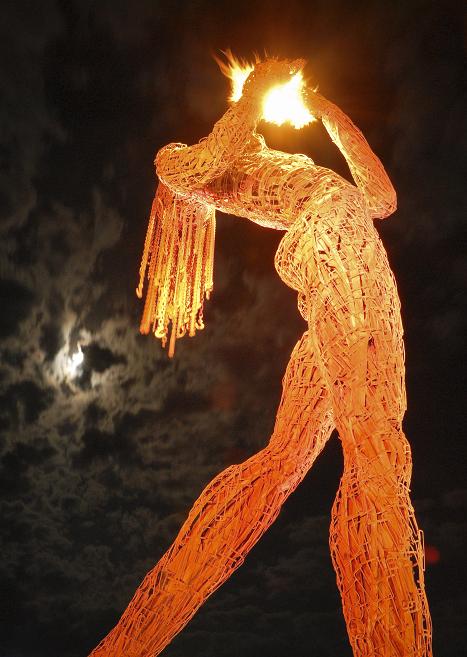
Burning Man is a “barter zone” – money is only allowed for use at the Main Tent for coffee, lemonades and for the purchase of Ice. Otherwise, you can leave your wallet back where “civilization” rules. The Burning Man experience is so creative, large and literally engulfing, that you find yourself contributing. In the end, in fact, this is the energy behind the event. It has indeed become something of a culture of its own, led by enterprising artists and Internet-savvy art geeks and it provides a wonder of stuff – nearly indescribable, really. Night time scenes see amazing high tech lighting and nocturnally-inspired art work:

And the “Mobile Art”, lol. The Art Cars have institued their own world of whimsy, now featuring an Art Car Festival in Houston, Texas and a natural outgrowth of the male need to tinker and play, lol. Needless to say, these were always my favorites:


Some are just for fun


Some are more serious:


And these are just the “cars”. The art?

This is what grownups can do, lol…………

A pretty solid visual feast, no matter how you look at it.

Then it disappears – in 3 days, it will be as if no one had even been there.

From these, the Fire Temple of wood, above and two years of The Man below:

2008:

From this……….


To this:

It’s all good, interesting, exciting and always weird – which is the point. It’s is the single most Artistical Artical Event ever.
Kablooey!


July 9, 2011
Using various grasses in landscapes is not particularly new. Dating back from a period when the UK’s interest piqued towards the new Pampas Grasses, imported from the more arid South American countries, grasses soon made their usefulness spread to the wider world. It’s certainly easy to see the attractiveness of Pampas Grass, and even more so when their sheer size and rather stately presence becomes bedecked in such gorgeous seed fronds as those show below.
(click any image to enlarge)

The truth is, grasses were especially greeted owing to how these large broom-like fronds manifested. Their dried effects have become highly desirable in indoor settings, often dyed but always soft and sturdy. There’s really nothing quite like them.

But the more intrepid gardeners and landscaping aficionado’s stayed hard at work, developing and hybridizing yet more oodles of newer grasses. The results are simply mind-blowing. It does seem that grasses are receiving more innovations than nearly any other garden/landscape species. Here is a bizarre plant, full of the most unusual potentials -note the color!
This is the Panicum Virgatum “Prairie Sky“.

I’m not sure we were entirely ready for blue blooms on grasses, although, to be honest, after seeing the wonderful Muhly Grass (Muhlenbergia Capillaris) which is being more widely used as accents in landscapes, one should probably not be the least bit surprised:

The blooms seem to be the thing, so far, and with ample reason……………and yet…………….
We find ourselves, as designers and plant lovers beset with a range of options which is nearly brand new – and offering entirely new effects to present to the wider cosmetical world.

The very shapes and forms of these gorgeous species make incredible “edge softeners”, appearing in a fuzzy tight globular form even prior to the emergence of their lovely fronds. As a pure shaped effect, the roundness and soft lines of these various grasses do not even take advantage of their other attributes, which can include variegation and strange and very colorful striations:

They mix well with other plants, such as lilies, as evidenced here in the Papa John’s Pizza world headquarters in Louisville – a fascinating bit of landscaping a bit East of town which features not just these gorgeous grasses but an extremely impressive waterfall and lake.

In appreciation of someone’s elegant craftsmanship, the waterfall at Papa Johns:

Some of my favorite grasses we implemented along the mosaic pathways at the Portland, Oregon Chinese Garden, during the construction of that killer city block’s worth of ancient and white hot landscaping:

One can readily observe the referred-to “softening effect” of such charmingly lumpy and colorful small plants which – when massed – provide the beginnings of a virtual embrace by the landscaping surrounding this well-crafted walkway.
Smaller and less awe-inspiring grasses such as these rather simple, non-invasive clumps of delicate-bladed grasses, bend in the wind, offering a kinetic green presence which amplifies the senses and presents us with a helpful presence in spotlighting these gorgeous glass sculptures displayed here at Yew Dell Gardens in Louisville as produced by local high school artists and offered for sale at the time.

Grasses can add “peculiarity” to an otherwise somewhat normal environment, not simply because of the fronds, but with the content of its shape as well.

Highlighted here by a load-bearing Sun, the magical look is achieved in the gorgeous fronds of this Miscanthus as the sun highlights it’s crystal-seeming clarity.

I have become an outrageous fan of grasses in general. When combined with the various sedges and water grasses such as Papyrus, the realm of these plants goes from arid to swampy in short order, offering a range of planting possibilities it is nearly impossible to lose at.