
We already know why we cut pavers – they “finish” things. A good-fitting brick paver is a treat to an installer’s eyes – and he may just be the only one, in some cases. In a few years, often times plants grow over the edges of those crisp lines, or even grass. All that slick-looking work won’t show up again for 10 years, when the owner decides the plants have grown too dam big. Then he will suddenly go: “Wow, those guys really were good!”
(to enlarge any pictures, left click)
We take the approach that what we work on is permanent. The actual fact of the matter is, many of these driveways and patios will literally outlive the houses they abut. We realize this and I design and install thinking 3-4 generations of plants ahead. I fully expect the perennials in the picture above to be dug up and changed out possibly 20 times during the life of this combination driveway and patio. It’s what happens when you deal with the best products. It’s also what happens when you bother to prepare what’s under them adequately.
And we believe the same precepts apply in the walls we build.
And we cut wall blocks much the same as we cut pavers. Some blocks fit perfectly on the table of a large saw, sporting that wonderful device – the diamond saw blade – encrusted with industrial diamonds which can tear through just about anything, and particularly concrete products.
I’ve owned a pretty good number of saws in my day. The one pictured above ends up being what I found was the most useful for paver work. It is electric and, of course, as can be seen, it runs with water forced onto the cutting surface which serves to cool down the diamond blade and – most importantly – to keep the dust down. Cutting through bricks – especially cement ones – creates an enormous amount of dust. The particles cut are absolutely tiny. Modern electrical saws these days can run on far less amperage then they used to. There was a time when we would shut down breakers in a house from the stress on the electrical circuit. Now, better ball bearing technology and advances in more efficient motors has meant electrical saws can once again be considered usable and very dependable. The other very, very major advancement is in how much quieter they are than the gas powered engines which were what we used for long years prior.
Here is a floor model look at a powerful but noisy gas-powered brick saw:
Now, these cut faster, for sure. They have all the torque in the world. But they are tough for residential work, owing to their irritant factor. These will never be quiet – ever. But, for commercial work, they are clearly the state of the art. Just remember your earmuffs!
Next, we have the “art” of cutting. Those machines will all do the job. The “art”, however, is in making the perfect cut. The brick pavers it will take to make this look like a smooth consistent edge will take some real precision.
We typically work our way outwards from a house. This is primarily because near the home is where most of the traffic will eventually be and we want the largest possible pavers to service underfoot. Thus we end up looking like this on our way out to an edge.
As we close in on the outer edge, we lay as many completely intact pavers as we can. At that point, we begin cutting. I typically cultivate a two man team for this process. We have one guy marking where the pavers are to be cut and another guy on the saw. We can also waste pavers in the process of failing to get them to exacting standards. And, yes, I choose those standards. Where we do have a couple of tricks in our professional arsenal to make it look close to perfect, we also have a couple of tricks that can allow us to BE perfect.
We come to resemble this along the process:
Depending on the severity of the curve we are conforming to, straight lines can generally totally succeed at giving a curved look. And the saw only cuts straight lines. Oh, there are some artists who like shaving a bit, but that is Paver Cutting – Graduate Course. If you notice the pictures above and below, you can see how all the cuts at this project were straight ones.
It is just my opinion, of course, but in all my designs regarding pathways and patios, I have sided with form as at least equal to function – and it has led me to a sense that the curved line in design is the Natural Line. I see so few straight lines in Nature that my own biases probably create curves where none existed. But really, in fact, the remarkable discovery of straight lines in a natural setting is so unique, it would be a literal feature.
(click all images to enlarge)
What the implications are for landscaping means adding to the work – and, yes, sometimes quite substantially. How wonderfully easy it would be to run a nice straight course of paver lines – or even cement – and just go outward from there in some nice proportionate square box. There would be no need to tweak and twist pavers to conform to curves and there would definitely be very little cutting of the pavers. As a time-saver, this would be an obvious plus. And it is, definitely, sometimes a plus. There are places for squared-off patio pieces. Slammed in quickly, they give a functional appearance and practice. The one below, we added as nearly an afterthought.
And this patio was already there, ready to plant around, so we left it undisturbed and worked with it:
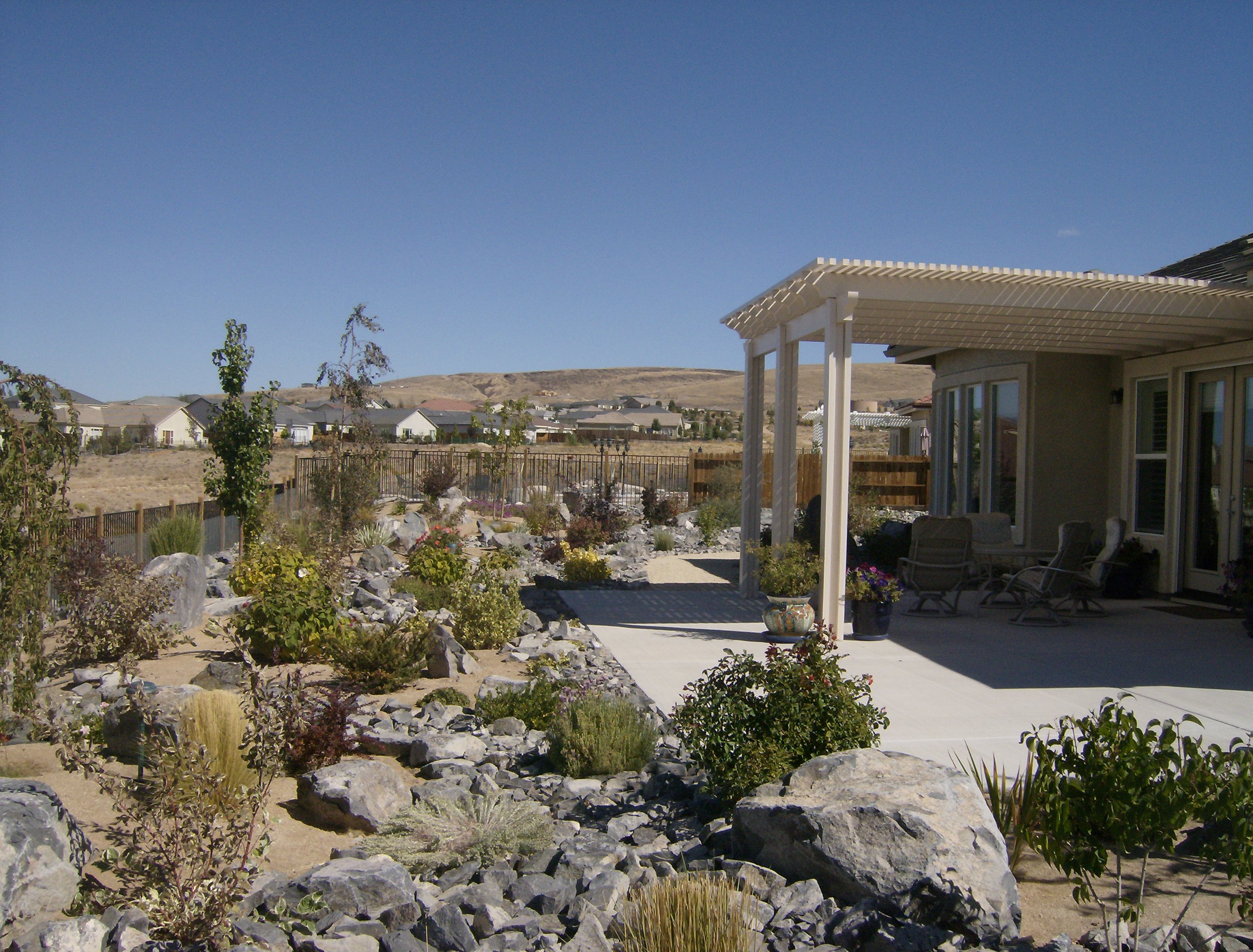
But I am about form and design as much as I am about functionality – equally, I believe.
In my experience, the curve is simply more natural and – if nothing else – definitely more interesting. Sometimes bordering on “Too Busy!” but still sort of fun.
The insertion of “elements of surprise” are another complete benefit of curving lines and the ability to adapt segmented pavers to an ideal. We do this by the act of cutting pavers to conform to lines drawn and to also when we adapt to obstructions or interesting insertions……which we also design.
Boulders, for example:
So we arrive at a simple conclusion: If we use brick pavers for our designed surfaces for walking, for driveways or for stair and wall constructions, we find out they can curve.
“Well, Whoopdeedoo,” I hear. “That’s great, Einstein. Tell us more we already know.”
Well, I get asked a lot about curving lines why I bother so much with them. I mean why cut to fit to make a more effective and attractive walkway, gal dangit? Or when you can just bend them a little bit individually to make a curving line, like this one:
If I had a choice, frankly, I would side with the “un-cut” pavers because I like the way the full sized pavers look, curving like that in a mass, like they are somehow really “in motion”.
These are a couple lightweight looks at just that:
This one below exemplifies it as much as any I ever did. It almost “moves” as you look at it. Enlarge it to really get the full effect. It is also worth mentioning that “Tumbled Pavers” – those apparently “antiqued” ones which they toss in a vat and tumble around in sand and among other pavers, smacking each other around and getting “rounded off and chipped slightly” – are the very best for curving intact. Regular pavers are pretty perfect – that ask for more uniformity.
So there we have pretty much the “Why?” of paver cutting. In order to get those perfect edges and rounded appearances out of what are basically rectangular or square origins, we need to cut them. And that is an art of its own. It takes time to develop a routine where a cutter and his set-up guy work together to produce this:
What’s amazing is that I am actually pulling off – knock on wood – quitting smoking. My Mom will be the Happiest Girl on the Planet, along with my other friends who could never reconcile my physical output and a habit so grotesque. Day 7 beckons ths morning with a sunny disposition and only the usual few thousand demons, waiting for me to slip up. In a way, I am most certainly rejoicing but I have had such a muted personal reponse to this all based on past failures. This is fairly tough.
With that borne in mind and this desk and computer one of the primary spots for my cigarette Jones, I have decided to spend a bit less time computing. The positive side of it is that I can supply some music easily enough and enjoy doing it. I’ll need to get normal soon I guess.
This is Mahalia Jackson, friends. I was of course surprised to learn how few modern people know of Mahalia – I have a now-19 year old daughter and I hang with some pretty young folks in general. They are not really sure who she is. I hope this helps. Mahalia Jackson is the reason Gospel Music even exists. I am positive the genre was made for her alone – the single most dominating singer of her generation.
Like Pearl Baily, Nina Simone, Dinah Washington and even Billie Holliday, Mahalia Jackson represents another era entirely of the stunningly-gifted Black Female Musician in an era where there sheer ability alone was their only path to any notoriety whatsoever. Well, as you can see, Mahalia brings alot to the table in this regard.
This clip effectively ends around the 4 and a half minute mark, but I think they included all the rest just to illustrate how Mahalia Jackson could electrify a crowd. You will agree this usually-disciplined European crowd is the definition of “electrified”. But there’s no music after that, just the wonderful grand lady of song – an irreplaceable musical personality – doing some of her trademark appeal to Peace and Love, God bless her. This, my friends, is SOUL.
There is no real charitable way to put this so I will say right off the bat – I am trying to quit smoking. Now, “charitable” would be describing the Tobacco plant as pretty – which it is. But today, I am on a different page entirely.
Being from Kentucky, and more specifically from Western Kentucky, there were abundant tobacco fields surrounding the town of Owensboro. One of my earlier jobs as a human was taking our 13 to 14-year old selves out to my friend Jimmy Walker’s farm and messing with the various stages of the tobacco they grew there. I recall sitting in this very bumpy and hugely awkward old “planter”, a two-seat, two-wheeled operation tugged behind a tractor, where we would insert small seedlings into the grooves of the planting device manually – drawn from our sides where we had access to bags of young seedlings, freshly-dug. We would place the seedling into the little deal and it would poke it into the ground – “Voila! – all planted and all actually kind of cool, really.
Don’t forget, we often got $10 a day for our efforts, too – a King’s Ransom at the time. It felt like stealing!
There were many benefits to this as well, make no mistake. Jimmy’s Granny lived nearby and she made “Granny Taters”. Now, I don’t know how many of you have had Granny Taters, but let me tell you, I have been trying to reproduce those things for years now, to some very pleased eaters. Boiled in milk and butter to a specific softness, some sour cream and some more butter added later, a little salt and pepper – wow! Jimmy’s Granny obviously carved herself a niche in my life, right through the tummy!
And we got to drive stuff. We could drive a tractor on the open road, almost as if we really had drivers licenses because farm machinery is exempt. You see 8 year old’s driving tractors out in them boonies. There can be some disappointments, too, of course. Such as the time we got that tractor really moving and we were hauling a manure spreader (now there’s an exotic machine!) behind us and we tried to stop too fast or something. All we knew was, here we were going downhill, the 3 of us (the equally-idiotic Bernie Smith joined our crew for the day), and we looked left and by Golly that old manure spreader was just plain passing us up! We even got to watch it land, it’s attaching fork out in front making it take a big flip, end over end, into the brush by the road. So there were some good stories to the tobacco saga in my past.
But they are less interesting now.
I actually think I might even make it this time, truth is, owing to the condition I found myself in the other day waking up which may not sound so bad to some but which to me was the worst sensation I believe I ever had. I felt a very sore throat complete with a rattling sound and hurting lungs – now how sweet is that? I mean, I have probably felt that bad in the past but this has finally become too much. I decided to announce it to the world so that shame itself – if nothing else – might act to keep the status quo of zero cigarettes until I can at least get by the worst cravings.
One of the true benefits of having your own blog is that you can pretty much do whatever the heck you want. Notice, I don’t rant on politics or even the sports I follow as a fan and participant. But I love sharing music. On a strictly personal basis, sure, it shows something about me, but that is also a part of the blogging game. Why not? A little soul never hurt anybody. There’s enough real work I have done in here to merit a change of pace. Rocks and roses are great. Sometimes. But music is always great – all the time.
I love this guy. I have always been a big Staples Singer fan – great blues/gospel music of a very American sort. But Pops brings something extra to the game, in my opinion. I am even going to place 2 videos in here – something new for me. I realize it;s asking a lot for someone to have to wade through a couple of videos, so maybe you can return and catch the second one sometime. The first is from a cute movie: “True Stories”, by David Byrne featuring an all star cast and some hilarious vignettes of American Midwestern life, featuring weird stories from US tabloids. In this video, Pops has been called in to help a poor heart-broken lady who refuses to leave her bed until her beau shows up to rescue her. He applies some voodoo to the problem. The second one is just Pops, solo. The German Subtitles are cool, too.
No trip to the Portland Rose Garden should omit mentioning the Miniatures they have there. Actually, they are arranged in two or three different places, including – as the picture below shows – a “test garden” for varieties they are working into their rotations.
(click on any image to enlarge)
Following through with what I already revealed elsewhere to be my own sinful sort of relationship to roses in general, I am so adoring of those which mix and blend the bloom colors – or those which change during their own brief maturation.
These two-colored miniatures just really struck my fancy. I would so love putting some of these in myself someday and I do plan on it. And, yes, there have been occasions when I have planted miniatures in my own projects – far more than I may have led us to believe. Working with as many rockeries as I have, they fit like Alpine Perennials into the cracks and folds of rock arrangements and do so with some startling durability.
We now move to those which change on demand. Or seem that way, at least. If you don’t much care for the colors of these roses, you should just come back tomorrow when they look different!
More red and whites in yet another area of miniatures, I’m afraid my biases have left out some other gorgeous choices.
These orange ones, for example, are simply radiant. They are also profuse as they can be.
The yellow rose below I liked not only for the perky and effervescent color but I also was most attracted to their wild bloom formation – almost star-like. It seems a complete departure from the standard rose petal.
These shown below look somewhat bedraggled and all and, the truth is, we did catch them on the downside of their prime blooming era. But not by much! Simply beautiful, one can see what they bring to the party and why I would still opt to feature them, even if they are half-past spent. Indeed, these were a real favorite of mine, revealing yet another sort of petal formation – more like a spray.
And now we move to another dimension of the Portland Rose Garden – its overall landscaping, disregarding for a few moments the extreme gorgeousness and ridiculous profusion of the roses they feature.
Below is a Hardy Fuschia, hard by a grouping of rose blooms but over by the overall edge of things where a hedge separates the Rose Garden from a very tranquil small garden setting, composed primarily of plants and grass.
Here is the other edge of the fuschia, looking backwards with the hardy fuschia at the remote end of this hedge and the killer plants in between. Hosta, arranged in a landscpaed form, separated by deer ferns stand out dramatically as they always do and with such a rich and hearty foliage and bloom.
Around the corner is the garden referred to. Incredibly tranquil and just gorgeous in its lushness, this is one of those classic gardens the screams for solitude and reflection (is that possible?).
The Astilbe looking all hot-to-trot mixes with the Hydrangea in the above picture to present a full vision of lush and quieting Flora. Bordered with the always-orderly Boxwood hedge, the anarchy gets toned down a bit, resulting in an enforced order that relaxes the eye as well as the senses. About this time, one could definitely lay out for a good nap.
Hydrangeas are actually another virtually “featured plant” on these grounds. And we are talking about all sorts of different Hydrangeas, by the way. The rosy pink blooms of this one below contrasts markedly with the blues of the ones following that.
Here is an orderly row of light-toned blues and whites, all bulky and full as they so often are.
And here is my personal favorite Hydrangea – a “Lace-Cap” bloom variety which has always stuck me with its different look. Profusely blooming, as is the wont of Hydrangeas the world over, this one seems somehow economical in it’s presentation, while still profuse. I find the blooms to be complex and minimized.
Yet another Hydrangea here, still among the “Lace-Cap” varieties, this one is stuck back in the depths of the garden so rife with perennials and ferns.
Another view of a Lace Cap blue, this one sun-washed and still-vibrant, I like the Begonia under, trying to assert itself among all the gigantic blue blooms.
Overall, this great urban garden features a wide variety of sights and pleasures, many of which are fairly unintended. Take some of these anarchistic-minded roses, for example, poking through the periphery of hedging surrounding the more formal display areas.
Here is another delicately-placed straggler looking as good as a plant can look while being allowed to basically just plain “roam”:
And, finally – speaking of Hydrangea’s – we have this interesting vine, long since overgrowing the building underneath it and now acting as a roof:
This is simply one of the most gorgeous gardens I have ever seen. It’s hard to get enough.
Everyone loves Roses. Hey, Niels, I have another Portland Rose Garden post!! (Niels is my Danish friend who runs Roses in Gardens – the link is in my “Blogroll” – and he may well be the single most knowledgeable person I know in the “Rose Love Business”.)
(click on all images to enlarge like crazy)
Let’s be clear, right off the bat. I was never that amenable to planting roses on my projects. Working as an installer, offering warranties on roses seemed suicidal, somehow, owing to their seemingly constant need for maintenance. Sure, I would plant some climbers on fences and posts, around gazebos and etcetera, but I always took more care with them than I probably should have. Unlike those nutty and stunningly hardy grapes, which seem to thrive in asphalt and the worst soils, roses always required extra amendments and all those things contractors under time constraints hate. I did find shrub roses, later, to be exceptionally hardy and I began a planting fest which continues to this day. If you notice in this little artificial mountain I planted for a couple in Reno, you can see what I mean. I used the deepest reds I could find, all of the Meidiland variety…………I found out these were extremely hardy and they needed little if any maintenance.
And, having said all that, there are few cooler plants. I visited the Rose Garden with my friend, Paul, yesterday and snapped about 100 pictures. He’s a landscaper with his own gig going and he had some time. We make this trip together about once a year and this year it was as wonderful as ever. I guess Portland is going to keep this garden around a while! That, my friends, sure seems to be a good thing.
I don’t know any of the Rose’s names. I do that act of willful ignorance purposefully, too. Delving that deep would require a commitment of energy I just cannot afford – why? – because there must be a doggone million names is why! Honestly, I do know a few – ‘Double Delight’ has always just “sent me”, I readily admit. The ‘Peace Rose’ grabbed my fancy as a child, so it has historical staying power. The rest? Let’s just say I like to think I know “pretty” when I see it. And there was a lot of “Pretty” at the old Rose Garden. This, to me, is pretty:
As you can see, I am especially taken by those roses whose blooms come out one color, then change as they flower. I am utterly fascinated by that. The miniatures I feature either later in this post or in Part 2 are especially prone to that. I am also fascinated by all those sexy multiple colors they now produce – as mentioned, the ‘Double Delight’ has always been a favorite – and the many variations of reds, whites, oranges and yellows you find in these exotic flowers.
And the smells! Oh my. Good Lord, that place should be against the law.
For a while, I thought it was me, actually. Imagine my disappointment when I discovered it was just the dang roses.
To be honest, we actually caught the garden in the downside of last week’s best possible display. It has cooled recently and we could tell the flowers we saw yesterday had just finished a remarkable breakout of blooming. Just the same, even with them at 90%, they tend to rock the senses.
I think the Rosecrucions were onto something. With more shovels, they might have amounted to something.
I am also a total sucker for the Lavender Roses. The problem with them seems to be getting the timing exactly right. Just the same, this one still looks good.
OK, for $100, how many blooms are there in this picture?
What the —-? Why is this Poppy in here? Pushy little bugger, eh?
Because there is more than just roses in this fabulous Garden. Here, for example, is the amphitheater, hard by the Garden, which is now featuring music nightly, throughout August. It’s frankly hard to imagine a nicer setting.
Incredibly, even huge people enjoy the garden. Face it, this is not the posture of someone whose Mom is making him behave – not that she ever could. Ex-football players have rights, too!!
Just as fortunately, they allow Mental Midgets to peruse the garden as if they were normal! The guy on the right here was delighted at the news!
The Portland Rose Garden offers far more than merely world-class roses in their prime. Always well-known and justifiably famous, the Rose Garden also benefits from features which would be their very own destinations, even without the gorgeous and World-Famous Roses.
It is, without doubt, a dramatic site. You get the sense of drama as you enter the place, with this peek at downtown on the descent into the garden itself.
Another view:
And then there are the immediate surroundings, which encompass the Rose Garden. Wow. The Weeping Beech Tree in this photo and the one following offers a dramatic sweep of cascading lines, almost waterfall-like, easily matching the impressive impact of those giant Douglas Firs around and forming the virtual walls of the garden itself. Protected by these behemoths, the garden gives an amazing serenity – cutting out noise and urban pollutions and allowing to focus on such small things as Roses.
But it is the statement made by the Beech which causes my wonder at the foresight of those who planted it where it is. See if you agree with me:
For my money, a “better” look:
And here, the sense of “Enclosure” which is so forceful and quieting:
Make no mistake, the quiet of this Garden is unrivaled in any other Garden outside of possible the Portland Japanese garden which is across the street. I am not sure this is not the most ideal setting for a garden of its type I have literally ever seen.
This little purple flower seems to agree:
Thanks for joining the Mental Midget on this painful exercise in flower-gawking.
Next? After yet another interminable post about this little garden, I promise I will feature dirt. I know so many of you are waiting with bated breath on more posts about dirt and gravel. Be patient.
The above is a picture of my daughter on one of our rambles, back in the day (sniff, sniff) when she was much smaller than she is now. But it has always been a favorite picture, and not just for the obvious fact of a Dad inordinately in love with his own child. What she is standing on is the subject of the day here. That, ladies and gents, is Basalt – your basic igneous rock and one which has developed a huge niche in the desginer hearts and minds of landscaping people.
Basalt – most notably “Columnar Basalt” – is found in great accumulations in the Columbia River Basin, here in Oregon and across the river in Washington state. Other major concentrations are spread throughout the world in places like the Giant’s Causeway (Ireland), Organ Pipes National Park (Australia), Devil’s Tower (Wyoming, USA), Russia, India, Iceland and many other locations. Formed into crystalline formations and often referred to as “hexagonal” – 6-sided – they can actually vary into polygons with anywhere from 3 to 12 sides. From Wikipedia: “Formed by the cooling of lava on the Earth’s crust, during the cooling of a thick lava flow, contractional joints or fractures form. If a flow cools relatively rapidly, significant contraction forces build up. While a flow can shrink in the vertical dimension without fracturing, it cannot easily accommodate shrinking in the horizontal direction unless cracks form; the extensive fracture network that develops results in the formation of columns.”
It then goes on to say that the slower the cooling process, the larger the columnar “crystals”. I have seen some very large crystals in my day – and even used a few. Later pictures in this post will illustrate this.
This is a smaller scale use within the confines a modern landscape and water feature in a retired couple’s small back patio area. Actually, this is a project which may have used the fewest basalt columns of all, but the location of the foreground “seat rock” does present an excellent minor vision of the polygonal aspect, as well as just one of many functions columnar basalt can be put to use for in a landscape. They do not have to be large to be quite effective. Their horizontal lines also present us with the gift of altitude and, therefore, perspective.
Harvested from vast fields of these crystals, as remarkable as we regard them, they are hardly rare, as the production picture from a Chinese Basalt source shows us below. The fact is, their large numbers bode well indeed for landscaping possibilities.
Bored right down their length and with a water pump hidden amidst the lower levels, they make excellent “Bubble Rocks”, for one thing. Bubble Rocks give the more gentle sound of water and bring out the rich color which is hidden in all rocks:
But there are larger and more forceful roles available for columnar basalt. Notice this waterfall the company I was with at the time built for Microsoft’s Campus in Seattle, Washington. Its construction resembles the picture of many basalt sources throughout the world in high mountainous regions. This was a pain-staking project but remains one of my very favorite constructions.
Below are pictures of other uses for this interesting material. These pictures are all taken at the Portland Zoo, a minor landscaping miracle utilizing the local products in novel ways – as seats and as retaining wall effects. This is hard by the zoo’s own bus stop leading to the buildings housing the elevator which takes people down about 500 feet to where they can catch the Light Rapid Transit train.
Hey, I think the theory here was: “If you got ‘em, flaunt ‘em!”